“Create great content and links will come” is not a plan. Neither is buying a guest post from a website nobody in your market reads.
A linkable asset is different from a normal blog post. It helps someone complete a task, inspect evidence, compare options, or understand a place. It gives reporters, local organizations, other lawyers, and residents a reason to cite your firm that has nothing to do with being asked for a favor.
GJEL Accident Attorneys’ San Jose Crash Map is a strong example. The firm turned official collision records into an interactive explorer, local reports, rankings, downloadable tables, and a documented methodology. It is valuable to the public whether or not it ever earns a link.
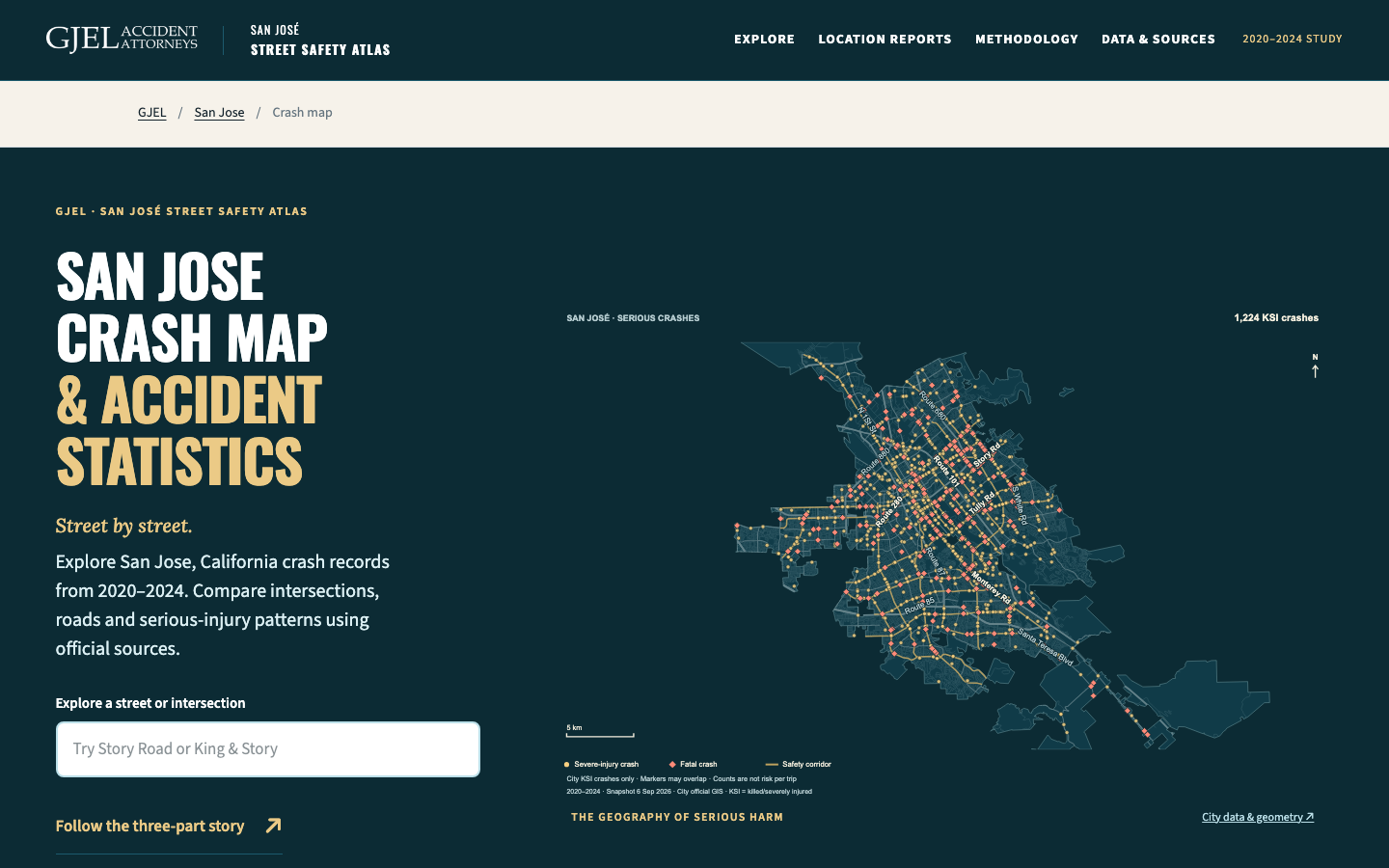
The flagship view combines a searchable public tool with an immediate visual story. Screenshot: GJEL Accident Attorneys.
Your firm does not need to match that project’s scale. A small, careful resource for one county can be more useful than a giant generic guide.
Nine ideas worth stealing#
1. The courthouse first-visit guide#
Visit the courthouse and document the details official pages tend to scatter: entrances, security rules, parking, public transport, accessibility, filing windows, childcare policies, and where visitors commonly get turned around. Link to official sources and date every verification.
Best fit: criminal defense, family law, immigration, and civil litigation firms.
2. A county-by-county filing-fee explorer#
Turn public fee schedules into a searchable or filterable comparison. Link every figure to its official schedule and identify the effective date. Add alerts for fees that vary by matter or filing type.
Best fit: probate, bankruptcy, family law, and estate administration.
3. A dangerous-intersection mini-study#
Start smaller than an entire city. Analyze ten intersections near schools, hospitals, or a known corridor. Explain the source, time period, matching radius, and difference between crash frequency and crash risk.
Best fit: personal injury firms.
4. A local records-request directory#
Create one page that tells residents exactly where to request police reports, incident records, deeds, permits, court records, and administrative documents. Include official links, fees, processing estimates when published, and appeal instructions.
Best fit: nearly every local practice.
5. A legal-help availability map#
Map local clinics, court self-help centers, nonprofit services, language access, veteran resources, disability services, and eligibility rules. Make it useful to people the firm cannot serve.
Best fit: firms that want durable community and referral relationships.
6. A real local timeline tool#
Most “how long does a case take?” articles repeat national generalities. Build a visual timeline using your jurisdiction’s actual required steps, published agency timelines, court calendars, and clearly labeled firm experience. Keep estimates separate from legal deadlines.
Best fit: probate, divorce, workers’ compensation, and administrative practices.
7. A landlord-tenant notice library#
Collect official forms, plain-language explanations, delivery requirements, and effective dates in one maintained resource. Do not recreate forms that may change. Link to the authoritative version.
Best fit: housing and real-estate practices.
8. An accessibility audit of public buildings#
Use a consistent rubric to document entrances, lifts, toilets, hearing assistance, counters, and transit access. Invite corrections and publish the most recent inspection date.
Best fit: disability, elder-law, and civil-rights firms.
9. A recurring local data release#
Choose one public dataset the community cares about and publish a quarterly or annual update. Consistency is part of the asset. Reporters learn that your firm will have a clean table, a chart, and context when new data arrives.
Best fit: firms willing to own one subject for several years.
Pick the idea with the strongest “why us?”#
Score each idea from one to five on four questions:
- Does the public already ask this question?
- Does the firm have relevant knowledge or local access?
- Can the underlying information be sourced and maintained responsibly?
- Would someone use the result without knowing the firm offers legal services?
The highest-scoring idea is usually better than the one with the largest keyword volume.
A modest first version is enough#
You do not need an elaborate application. Version one might be a carefully researched page with a downloadable spreadsheet, a simple map, and ten verified entries.
Budget for the unglamorous work:
- source review;
- attorney review;
- data cleaning;
- accessibility;
- mobile testing;
- methodology and limitations;
- permissions for photos or downloads; and
- a process for updates and corrections.
A polished interface cannot rescue unreliable information. A plain resource with trustworthy sourcing can still become indispensable.
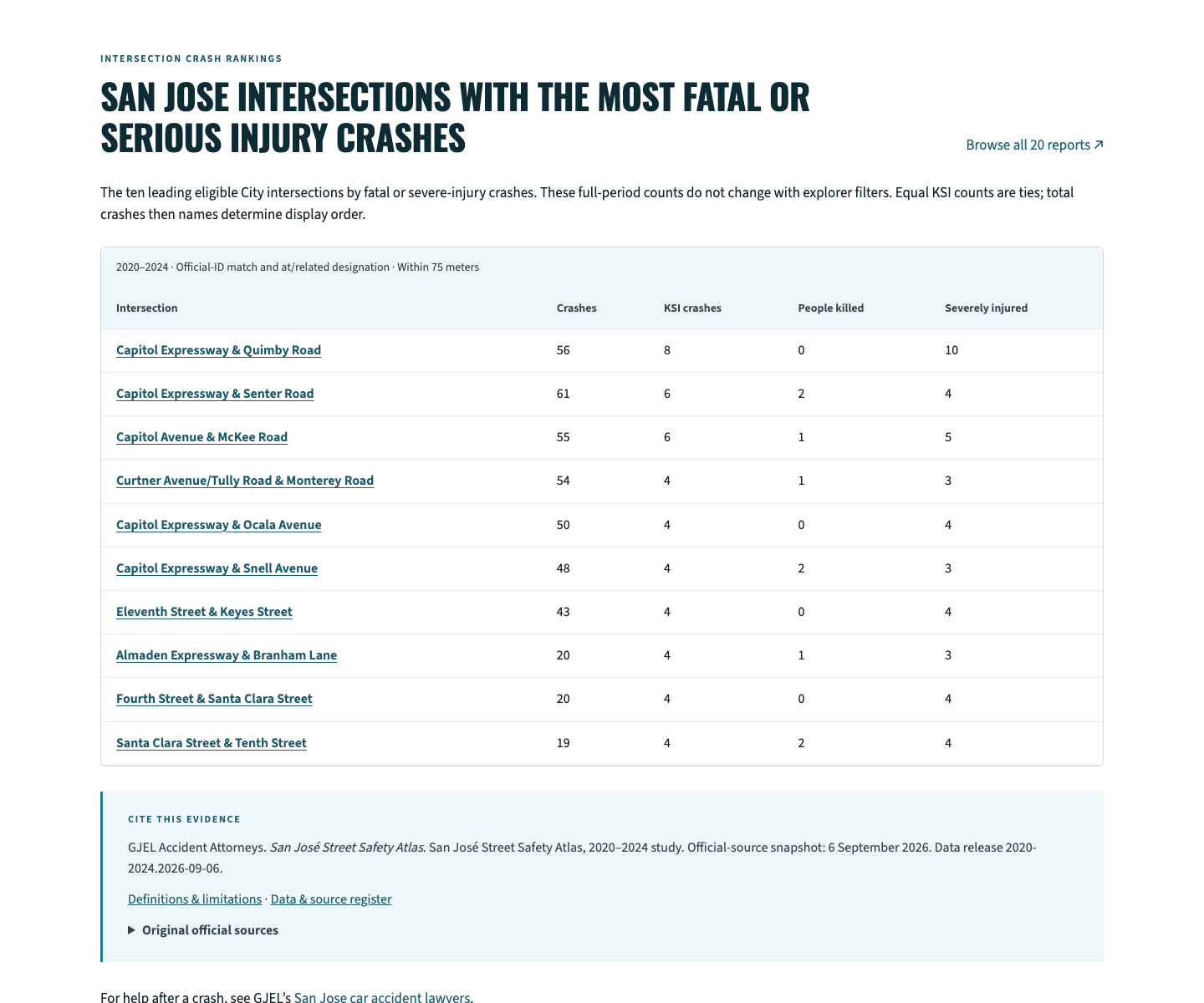
Notice that the ranked table is followed by citation language, definitions, and original-source access. Small firms can borrow this trust-building structure even when their asset is much simpler. Screenshot: GJEL Accident Attorneys.
Promotion should begin before publication#
Talk to the people who might use the resource while you are building it. Ask a local reporter which format makes the data easiest to use. Ask a nonprofit which information residents repeatedly fail to find. Ask another attorney what they wish they could send to people who are not a fit for their firm.
Their answers improve the asset and create a natural reason to follow up when it launches.
After publication, send tailored notes rather than mass outreach. Point each recipient to the part relevant to their audience. Offer a clean chart, the underlying table, and a short explanation of the method. Never make a link the condition for using genuinely public information.
Measure more than links#
Track earned links, but also track citations, branded searches, referral traffic, newsletter signups, media inquiries, community partnerships, downloads, and assisted consultations. An asset can strengthen the firm even when an important mention does not include a followed hyperlink.
The goal is not to manufacture proof of authority. It is to do authoritative work in public.
That is a much harder strategy to copy, and a much better asset for a small firm to own.